
Customer engagement has become fluid, dynamic, and deeply personalized. A single interaction may begin on social media, transition to live chat, move through email, and conclude with a phone call — all within minutes. In this hyperconnected landscape, being present across multiple channels is no longer a differentiator; it is an expectation.
What distinguishes today’s most successful organizations is their ability to deliver seamless, consistent, and humanized communication across every touchpoint. The omnichannel contact center now serves as the foundation of modern customer experience (CX), uniting people, data, and technology to create frictionless journeys.
What Is an Omnichannel Contact Center?
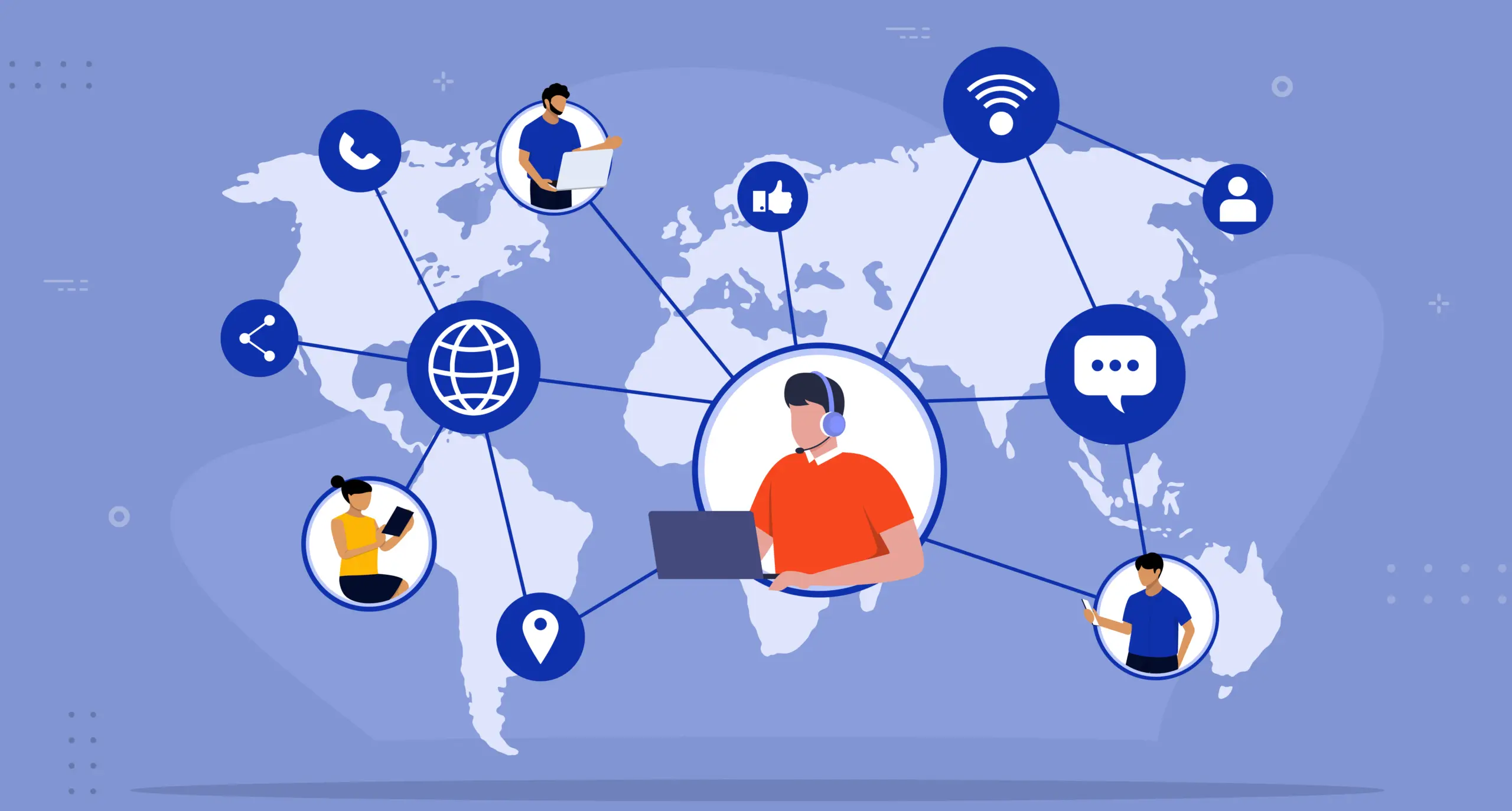
An omnichannel contact center is a unified customer engagement platform that connects voice, chat, email, social media, and messaging apps into a single, continuous customer experience with full context and personalization.
Unlike multichannel omnichannel contact centers, omnichannel platforms unify all interactions into a single customer journey instead of managing each channel separately.
1. Omnichannel: Beyond the Buzzword
Not long ago, offering multiple communication channels was considered an innovation. Today, it is the baseline standard. Research indicates that more than 75% of customers expect consistent service regardless of how they engage with a brand.
However, a true omnichannel approach goes far beyond offering multiple contact options. It focuses on integration and continuity, ensuring customers can move effortlessly between chat, email, social, and voice without losing context or repeating information. Meanwhile, agents have instant visibility into past interactions, enabling them to pick up exactly where the conversation left off.
This connected and contextual experience is what builds loyalty, satisfaction, and sustainable differentiation in 2026.
2. Foundations of Omnichannel Excellence
a) Unified Customer Data
Omnichannel success begins with a single, integrated view of the customer. Bringing together voice, chat, email, social, and SMS data into one unified profile gives agents the context needed to deliver informed and empathetic support. Organizations that eliminate data silos consistently report measurable improvements in customer satisfaction and retention.
A unified customer data layer enables agents to resolve issues faster, reduce customer frustration, and deliver interactions that feel informed, relevant, and human—regardless of the channel used.
b) Scalable Cloud Architecture
A cloud-native infrastructure provides the flexibility and agility required to evolve with customer behavior. Cloud platforms enable seamless integration of new communication channels, global scalability, and consistent service delivery — all critical for maintaining CX continuity in 2026.
c) Intelligent AI and Automation
Artificial intelligence is redefining the contact center, transforming it from a reactive service function into a proactive experience engine. Predictive routing, real-time sentiment analysis, and virtual assistants allow agents to focus on complex, value-driven interactions while automation manages repetitive tasks efficiently.
AI-driven omnichannel contact centers proactively identify customer intent, detect sentiment in real time, and guide agents with contextual recommendations, improving first-contact resolution and customer trust.
3. Key Trends Defining Omnichannel Contact Centers in 2026
Experience Orchestration in Omnichannel Contact Centers
Beyond routing interactions, modern platforms orchestrate end-to-end customer journeys—aligning marketing, sales, and support into a single, connected experience ecosystem.
Predictive Routing
Traditional queue-based routing is rapidly being replaced by AI-powered decision engines that anticipate customer intent and direct inquiries to the most qualified resource. This reduces wait times, enhances resolution accuracy, and elevates satisfaction.
Hyper-Personalization
In 2026, personalization goes far beyond addressing customers by name. It leverages behavioral insights, emotional tone, and contextual data to deliver interactions tailored to each individual. Organizations adopting personalization at scale are projected to realize up to 40% greater revenue growth than competitors.
The Voice and Video Renaissance
Voice remains a cornerstone of customer engagement, particularly complex or emotionally charged matters. With advancements in speech analytics, transcription, and AI-guided assistance, voice and video channels are regaining prominence as key pillars of omnichannel strategy.
Automation and Self-Service
Modern consumers value immediacy. Advanced chatbots and intelligent self-service tools allow customers to resolve common issues on demand, reducing agent workload while improving efficiency and satisfaction.
Analytics-Driven Empowerment
Data-driven insights are transforming both management and frontline operations. Real-time dashboards, sentiment monitoring, and predictive analytics enable supervisors to optimize staffing and empower agents to deliver more personalized, effective support.
4. The Omnichannel Experience in Motion
Consider a customer who begins an inquiry through WhatsApp, transitions to web chat, and then calls for follow-up. In a traditional setup, they would need to re-explain the issue at each step.
In an omnichannel environment, every message and detail moves with the customer. The agent immediately accesses the full history and context, ensuring a smooth and effortless transition.
Or envision an AI system detecting frustration in a customer’s tone and automatically routing them to an agent trained in emotional support. Wait times drop, empathy increases, and the overall experience improves dramatically.
Despite these benefits, only 36% of contact centers have achieved true omnichannel capability — revealing a major opportunity for innovation and competitive differentiation in 2026.
This level of continuity not only reduces average handling time but also significantly improves customer confidence, as interactions feel purposeful rather than repetitive.
5. Common Challenges — and How to Overcome Them
Eliminating Data Silos
Fragmented systems erode context and consistency. Implementing a unified data layer ensures that all customer information — across channels — remains accessible and actionable.
Driving Agent Adoption
Technology alone does not guarantee success. Employee engagement and training are essential. In 2026, leading organizations treat AI as a collaborative assistant, providing real-time insights and recommendations that empower, rather than replace human agents.
Maintaining Security and Compliance
As data volumes grow, so does the need for robust privacy, compliance, and ethical AI governance. Modern platforms must embed security, transparency, and accountability from the outset.
Balancing Automation with Human Connection
Automation improves efficiency, but human empathy builds trust. The optimal strategy blends both — allowing technology to handle routine interactions while agents focus on nuanced, emotionally driven engagements.
Organizations that succeed in omnichannel transformation prioritize platform integration, agent enablement, and ethical AI governance from the beginning rather than treating them as afterthoughts.
6. Why the Time for Omnichannel Is Now
Evolving Expectations: Customers demand fast, consistent, and context-aware service across every touchpoint.
Competitive Advantage: Seamless, personalized interactions are now a primary brand differentiator.
Operational Efficiency: Unified platforms streamline processes, reduce costs, and enhance agent productivity.
Strategic Growth: Modern omnichannel contact centers are evolving from cost centers into revenue-generating experience hubs.
7. How tryvium Powers the Future of Omnichannel Engagement
Built for the digital era of 2026, tryvium is a cloud-native omnichannel platform engineered to deliver intelligent, secure, and scalable customer engagement.
With integrated voice, chat, email, and social channels, AI-powered routing, and real-time analytics, tryvium enables organizations to:
Deliver seamless cross-channel transitions with complete context.
Provide hyper-personalized experiences powered by unified data and real-time insights.
Empower agents through AI-guided recommendations and contextual prompts.
Maintain security, compliance, and ethical AI standards across all interactions.
tryvium transforms traditional omnichannel contact centers into strategic CX engines, delivering faster, smarter, and more human engagement at scale.
Who Benefits Most from an Omnichannel Contact Center?
- Customer experience leaders and CX managers
- Enterprises modernizingomnichannelcontact center operations
- Mid-sized businesses scaling customer engagement
- Digital-first brands prioritizing personalization
Conclusion
In 2026, leading organizations will distinguish themselves not merely by offering customer support, but by orchestrating connected, compassionate, and context-aware experiences across every channel.
Omnichannel contact centers, powered by AI and empathy, represent the future of customer engagement — where each interaction strengthens relationships and reinforces brand loyalty.
With tryvium, your business can stay ahead of this transformation — redefining connection, empowering agents, and elevating the customer experience to new heights.
Experience the future of engagement — unified, intelligent, and human.
FAQs
1. How can omnichannel solutions improve customer experience?
Omnichannel solutions may talk about streamlined communication, where customers can actually reach the contact center across various platforms without losing its continuity.
2. How can I ensure data security in my contact center?
Ensure your best contact center software provider provides encryption, regular backups, and compliance with industry standards such as GDPR and HIPAA for sensitive customer information.
3. What are the benefits of cloud-based contact center software?
Cloud-based contact centers have flexibility in terms of scalability and can save cost. Cloud-based contact centers also support remote work for companies; they can adjust quickly to the changing requirements of the customers.