
Table of Contents
Share
Introduction
Customer service is not the same anymore. One can say it has transformed. The expectation is faster, more personalized support, while service teams are expected to handle growing demand with greater efficiency. Salesforce reports that AI is expected to resolve 50% customer service cases by 2027, up from 30% in 2025. Its 2026 research also found that 66% customer service organizations now use AI agents, up from 39% in 2025.
As AI adoption accelerates, simply adding more chatbots or automation is no longer enough. Organizations need AI agents that can understand customer needs, act, work across systems, and collaborate with human experts. This is where AI agent orchestration comes in, helping businesses coordinate AI and human capabilities to deliver faster, more connected customer experiences.
Agentic orchestration provides a way to coordinate these AI capabilities across customer interactions, workflows, enterprise systems, and human expertise. The result is a more connected approach to customer experience that can improve responsiveness, personalization, and service efficiency.
What Is Agentic AI Orchestration?
Agentic AI Orchestration is the process of coordinating autonomous AI agents, human experts, workflows, data, and enterprise applications to complete customer service tasks and achieve specific outcomes.
Traditional AI typically responds to a predefined request. Agentic AI can go further by understanding a customer’s goal, determining the actions required, using connected systems, and completing multiple steps with limited human intervention.
For example, a customer asking about a delayed payment may require several actions. An AI agent can identify the customer’s intent, retrieve transaction information, check the payment status, communicate the result, and create or escalate a service case if required.
An AI agent orchestration platform coordinates these activities so the right AI agent, human expert, workflow, or enterprise system is involved at the appropriate stage.
The purpose is not simply to automate individual tasks. The purpose is to coordinate intelligent actions across the entire customer journey.
Why Traditional AI and Customer Service Models Are No Longer Enough
Traditional customer service models are based on different systems such as chat, voice, email along with CRM ticketing and automation. Such systems may operate in a silo even when they profess to use AI.
Which leads to redundant customer details, unthreaded conversations, too many transfers, manual processes, less contextual information about the customer, conflicting answers and longer resolution time which makes it challenging for brands to provide efficient and connected experiences. Simple automation can manage predictable requests. However, many customer issues require several actions in various systems.
For example, a chatbot can respond to a question but may not be capable of executing the whole process relating to that question. This model is upended with agentic AI, enabling autonomous AI agents for customer service to act autonomously and offload tasks, align actions and escalate cases when human decision making is required.
Gartner predicts that by 2029, agentic AI will autonomously resolve 80% of common customer service issues without human intervention, potentially reducing operational costs by 30%.
Traditional AI Automation vs. Agentic AI Orchestration
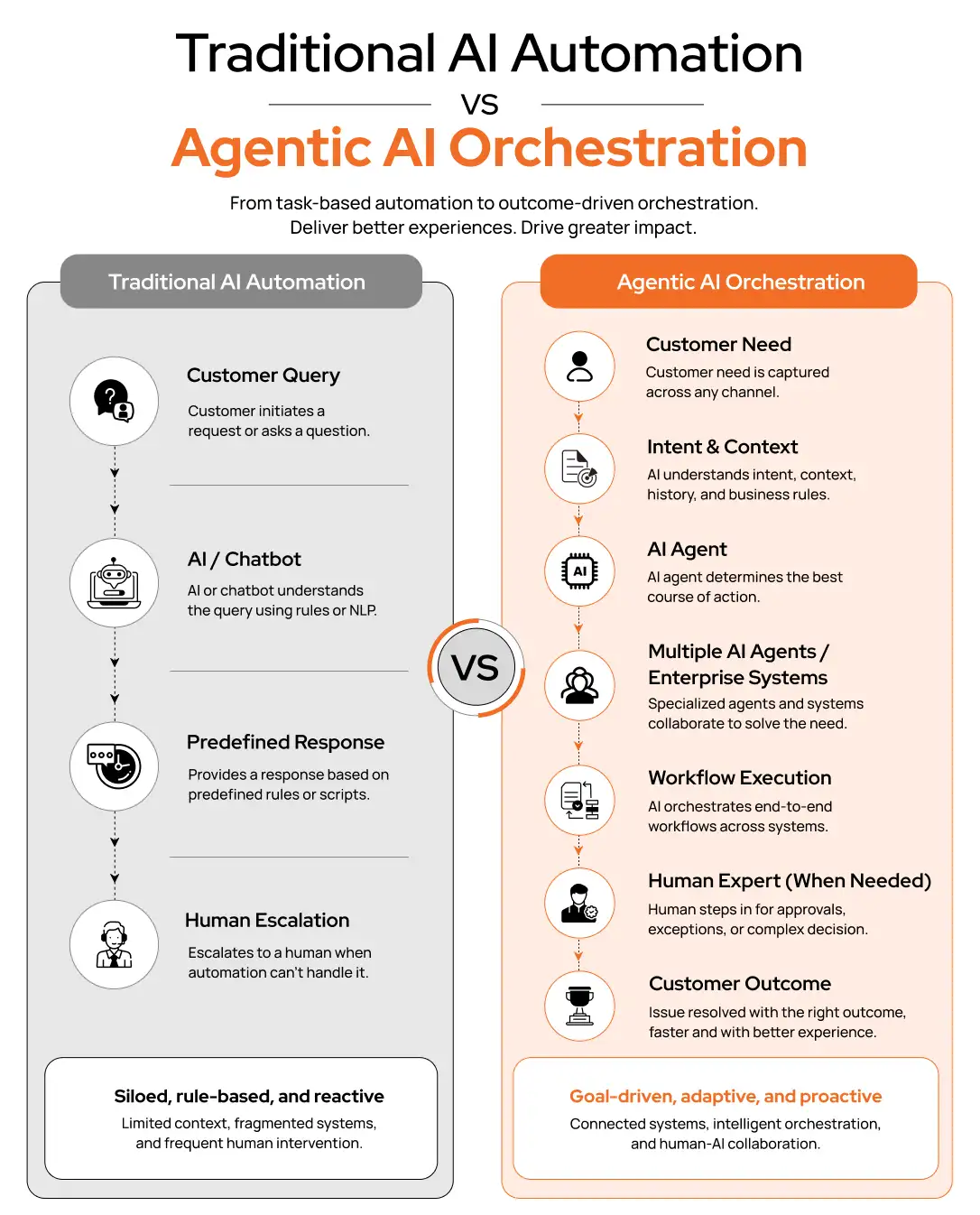
Traditional automation still has value for predictable processes. Agentic orchestration extends automation by coordinating multiple capabilities to manage more complex service journeys.
How Agentic AI Orchestration Transforms Customer Experience
Agentic AI orchestration can change customer experience in several ways.
Faster Resolution
AI agents can identify customer intent, retrieve information, execute approved actions, and complete routine processes without requiring customers to move between multiple systems or agents.
More Personalized Interactions
AI agents can use available customer and interaction data to understand context and provide more relevant responses, recommendations, and actions.
Seamless Human-AI Collaboration
When a situation requires empathy, approval, or complex judgment, AI can transfer the interaction to a human expert with the relevant context instead of starting the conversation again.
Consistent Service
Orchestration can apply business rules, workflows, and service policies consistently across channels and interactions.
Lower Customer Effort
Customers spend less time navigating menus, repeating information, or waiting for routine requests to be completed.
Proactive Customer Engagement
Agentic systems can recognize signals which denote that a customer likely wants something and take some measures, before the customer ever needs to contact support.
These capabilities can help organizations transition from a model of merely reacting to customer requests towards one of actively managing the customer experience.
Key Capabilities of an Agentic AI Orchestration Platform
A strong AI agent orchestration platform should provide capabilities that allow AI agents and human teams to work together effectively.
Autonomous AI Agents
AI agents can understand customer intent, make decisions within defined boundaries, and execute approved tasks with minimal human intervention.
Multi-Agent Orchestration
Specialized AI agents can work together to handle complex processes, with an orchestration layer coordinating their activities and actions.
Intelligent Decision-Making & Routing
The platform can determine the appropriate next action and route interactions to the right AI agent, human specialist, workflow, or system based on customer intent, context, and business rules.
Workflow Orchestration & Enterprise Integration
AI agents can initiate and coordinate workflows across CRM, ITSM, ERP, payment platforms, and other enterprise systems to complete tasks efficiently.
Human-AI Collaboration
Human experts can step in for approvals, exceptions, sensitive interactions, or decisions that require human judgment, while AI handles routine tasks.
Context, Memory & Analytics
Customer information and interaction history help maintain continuity, while analytics provide visibility into AI performance, customer interactions, resolution outcomes, and operational metrics.
Governance & Control
Security, permissions, compliance controls, approval workflows, and monitoring help organizations deploy AI responsibly while maintaining control over AI actions.
Together, these capabilities form the framework for implementing agentic orchestration at an enterprise level.
Key Considerations When Choosing an Agentic AI Orchestration Platform
Organizations evaluating agentic orchestration solutions should look beyond the ability to deploy individual AI agents. The platform should support the broader service environment.
Key considerations include:
- Multi-agent capabilities to coordinate specialized AI agents
- Enterprise integrations with existing applications and data sources
- Workflow automation for end-to-end process execution
- Human-in-the-loop controls for approvals and complex situations
- Security and governance for responsible AI deployment
- Scalability to support growing interaction volumes
- Analytics and monitoring to measure performance and outcomes
- Omnichannel support across voice and digital channels
- Context management to maintain continuity across interactions
- Flexible microservices architecture that allows organizations to expand AI capabilities over time
The right platform should fit into existing service operations rather than requiring organizations to replace every system they already use.
How Tryvium Enables Agentic AI Orchestration and Transforms Customer Experience?
Tryvium is an AI-led Experience Orchestration Platform that helps enterprises to orchestrate a network of AI agents, human experts, workflows and enterprise systems in a single service environment.
Tryvium achieves AI Agent Orchestration by dynamically orchestrating Autonomous AI Agents, human experts, business workflows and enterprise applications. Tryvium does not just treat each AI agent as a standalone automation tool, it coordinates their action within the end-to-end customer journey.
Tryvium achieves AI Agent Orchestration by dynamically orchestrating Autonomous AI Agents, human experts, business workflows and enterprise applications. Tryvium does not just treat each AI agent as a standalone automation tool, it coordinates their action within the end-to-end customer journey.
This method also facilitates a more gradual implementation of AI. While organizations can embed autonomous capability in limited domains, the human retains control for exceptions, approvals and complex decisions.
Frequently Asked Questions (FAQs)
1. What is the purpose of agentic AI orchestration?
Agentic AI orchestration is the coordination of AI agents, workflows, enterprise systems, and human expertise so that they all can cooperate towards a particular customer or business outcome. It provides AI the ability to orchestrate across systems, manage complex requests and seek human experts whenever there is a need to do so.
2. How is agentic AI different from traditional AI automation?
Traditional AI automation typically performs predefined tasks or generates responses. Agentic AI can understand goals, plan actions, use connected systems, execute tasks, and adapt its actions within defined boundaries.
3. How can agentic AI orchestration improve customer experience?
It can reduce customer effort, accelerate resolutions, personalize interactions, maintain service continuity, and coordinate AI and human expertise throughout the customer journey.
4. What should organizations look for in an AI agent orchestration platform?
Multi-agent orchestration, enterprise integrations, workflow automation, governance, human-AI collaboration, analytics and insights capabilities, security, scalability and omnichannel are among the parameters that organizations must assess.
5. How does Tryvium support agentic AI orchestration?
Tryvium brings Autonomous AI Agents, human experts, workflows, enterprise applications, and customer interactions together in an Experience Orchestration Platform to support connected and intelligent service delivery.
 Cookie Consent