Table of Contents
Share
Introduction: Microsoft Teams Is More Than Just a Collaboration Platform
Microsoft Teams is already part of the technology environment for many enterprises. Employees use it to communicate and collaborate, and organizations rely on it to support everyday work.
However, the service environment around Teams is often fragmented. IT service management (ITSM) platforms, customer relationship management (CRM) systems, AI agents, and customer communication channels may operate independently, creating disconnected workflows and inconsistent experiences.
The challenge is not simply adding another tool. It is connecting the systems, people, and interactions involved in resolving service requests.
Tryvium for Azure extends Microsoft Teams into service operations, helping organizations orchestrate employee support and contact center service through AI agents, human expertise, workflows, and existing enterprise systems.
Microsoft Teams provides the foundation. Tryvium helps coordinate the service journeys built around it.
Why Organizations Need Unified Service Experiences
Employee experience (EX) and customer experience (CX) are often managed through separate platforms and processes. Although their users and objectives differ, both depend on timely responses, relevant information, and effective resolution.
Tryvium brings these experiences into a connected service model.
Employee Experience:
Simplify Support and Accelerate Resolution
Employees need an accessible way to get IT support, find information, and request internal services without unnecessary delays.
Through Microsoft Teams, Tryvium can support AI-powered self-service, allowing AI agents to understand requests, retrieve relevant knowledge, and initiate defined workflows. When a request requires human expertise, organizations can route it to the appropriate support team.
Key benefits include:
Faster service resolution: Automate eligible routine requests and reduce manual effort.
Familiar employee experience: Access support through Microsoft Teams.
Improved productivity: Help employees spend less time navigating support processes.
Connected workflows: Bring together knowledge, systems, and human assistance.
Customer Experience:
Orchestrate Journeys Across Channels
Customers expect convenient ways to engage with businesses and get their requests resolved. Tryvium can support customer interactions across channels such as voice, web chat, and WhatsApp.
AI agents can assist with defined use cases, access relevant information, and initiate service actions across connected systems. Human agents remain available when a request requires judgment, additional context, or specialist expertise.
Key benefits include:
Omnichannel engagement: Support customers across available communication channels.
Action-oriented service: Move beyond answering questions to initiating service tasks.
AI-powered assistance: Use AI agents to support defined customer journeys.
Human involvement when needed: Bring human expertise into the service process for more complex requests.
One Platform. Two Orchestrated Experiences.
Employee support and customer service have different requirements, but they can benefit from a shared orchestration approach. Tryvium helps coordinate AI agents, workflows, connected systems, and human expertise without requiring organizations to replace every system they already use.
From Collaboration to Service Operations: The Role of Microsoft Teams
Tryvium is not simply another communication channel within Microsoft Teams. It is a solution built on top of Teams, leveraging its functionality and extending it to support IT service management and contact center operations.
Teams can provide the familiar environment employees use to access internal support, while customers can engage through external channels such as voice, web chat, and WhatsApp.
This distinction gives organizations flexibility. They can build on their existing Microsoft Teams investment while extending their service capabilities beyond collaboration.
With Tryvium, Teams becomes the foundation for connected service operations rather than just a place where conversations happen.
Powering Employee Experiences Through Teams
For organizations looking to improve IT help desk operations and employee support, Tryvium brings service interactions into the Teams environment.
AI-Powered Self-Service
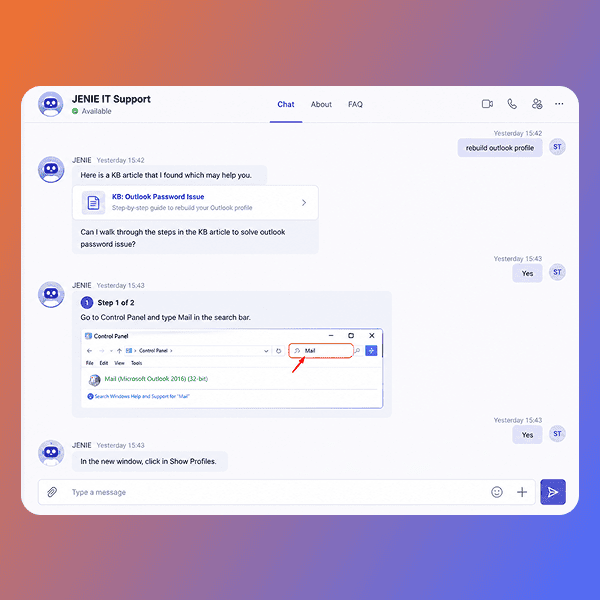
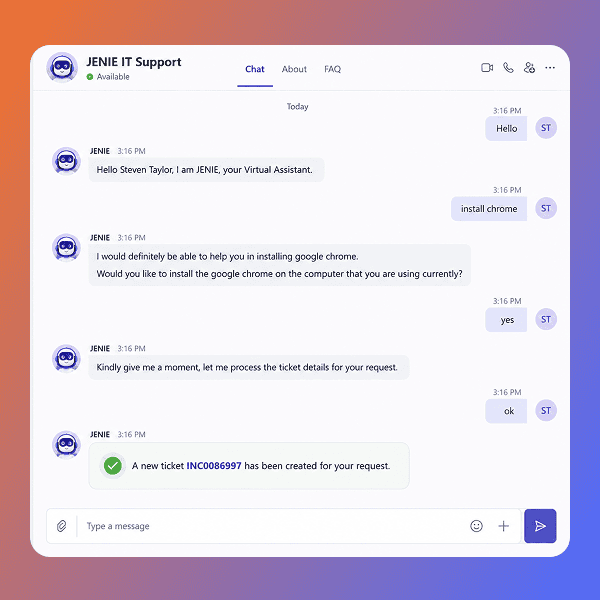
Employees can begin their support journey through an AI-powered self-service agent. The agent can address defined use cases, helping employees access information and support without requiring every request to be handled manually.
Organizations can determine which requests are suitable for automation and configure the service journey around their operational requirements.
Human Agent Escalation
Not every request should be handled by AI. When an employee needs assistance beyond the AI agent’s defined use cases, the interaction can be transferred to a human agent for further support.
Tryvium also gives organizations control over how AI and human support work together. Management can define bot flows, determine which use cases are appropriate for self-service, and decide when human intervention is required.
IT Support & Service Requests
Employees can access IT support through Teams, while IT teams use the service capabilities available to manage these interactions. This approach helps organizations build employee support into an environment their teams already use, rather than requiring a completely separate employee-facing experience.
Extending Teams to Customer Experiences
The same orchestration approach can extend beyond internal employee support to external-facing customer service.
Supporting Multiple Customer Channels
Customers may prefer to connect through voice, web chat, or WhatsApp. Tryvium can support these channels as part of a broader service environment built around Microsoft Teams.
This gives organizations flexibility in how they engage with customers without limiting the service experience to conversations that take place inside Teams.
Coordinating AI and Human Assistance
Organizations can define which customer requests AI agents should handle, and which require human support. AI can assist with eligible interactions, while human agents can take over when additional expertise or judgment is needed.
The objective is not to automate every interaction. It is to coordinate the right combination of AI and human assistance to move each service request toward resolution.
Connecting Teams With the Enterprise Systems You Already Use
Organizations have already invested in ITSM platforms, CRM systems, endpoint management tools, and AI solutions. Adopting a new service model should not automatically mean replacing those investments.
Tryvium is designed to work with existing enterprise environments, connecting service journeys across systems where the required integrations are supported.
ITSM Platforms
Organizations may already use platforms such as ServiceNow, Zendesk, or Freshservice to manage IT service workflows.
Tryvium can help connect these environments with the broader service experience, allowing organizations to retain their existing ITSM investments rather than replacing them solely to introduce a new interaction model.
CRM and Business Systems
Organizations can also continue using their existing CRM and business systems. For example, a business using Salesforce as its CRM and ServiceNow as its ITSM platform can retain those systems while connecting them with Teams and Tryvium, subject to the required integration capabilities.
This approach helps organizations build on existing technology rather than create another isolated environment.
Existing AI Agents and Bots
Some organizations may already have AI agents built internally or acquired from other providers. Tryvium’s orchestration approach allows organizations to incorporate existing AI capabilities into the broader service journey where supported, rather than assuming every capability must be replaced.
Keep the systems that work for your organization. Connect them. Orchestrate the service journey.
Where Tryvium Fits: Orchestrating Employee and Customer Journeys
The value of Tryvium lies in coordinating the different components of a service environment.
An organization can use AI capabilities available within its solution while retaining external AI agents, existing ITSM and CRM platforms, and the communication channels relevant to its service model.
Instead of treating each component as an independent experience, Tryvium provides an orchestration layer that helps connect them.
AI agents can handle defined tasks. Human teams can manage requests that require their expertise. Enterprise systems can continue performing their established roles.
Tryvium brings these elements together to support more connected employee and customer service journeys.
The Business Value of a Teams-Based Service Model
A connected service model can offer operational benefits beyond technology consolidation.
Reduced Tool and Vendor Complexity
Managing employee support and customer service through disconnected environments can increase operational complexity. By connecting service workflows through a common foundation, Tryvium can help organizations reduce fragmentation and simplify how their service operations work together.
Improved Operational Efficiency
AI-powered self-service can support defined requests, while human teams focus on interactions that require their involvement. Organizations can configure this balance according to their needs and operational priorities.
Greater Value from Microsoft Teams
For organizations already invested in Microsoft Teams, Tryvium extends its role beyond collaboration. Teams can serve as the foundation for employee support and, alongside external communication channels, customer-facing service operations.
Flexible Service Operations
Organizations retain control over their service model, including:
- Which use cases should be handled by AI.
- When human support is required.
- Which ITSM and CRM platforms to retain.
- Which existing AI agents to incorporate.
- Which customer communication channels support.
This flexibility helps organizations evolve their service operations around their requirements and existing technology investments.
Who Can Benefit from a Unified Teams-Based Service Experience?
- Improve service efficiency while managing operational costs.
- Extend their existing Microsoft Teams investment.
- Address gaps in their current service environment.
- Connect employee support and customer service operations.
- Reduce fragmentation across tools, platforms, and workflows.
- Retain existing ITSM, CRM, and AI systems while connecting service journeys.
It can be especially relevant to enterprises that manage IT service management and contact center service as separate environments but want a more connected approach to service delivery.
Conclusion: Turning Microsoft Teams into a Unified Service Experience Platform
Microsoft Teams already provides a familiar foundation for collaboration across many enterprises. Tryvium extends that foundation into service operations, helping organizations connect employee support, customer engagement, AI agents, human expertise, and existing enterprise systems.
Employees can access IT support through Teams, while customers can engage through channels such as voice, web chat, and WhatsApp. AI can support defined service tasks, human teams can step in when needed, and existing platforms can remain part of the technology environment.
The opportunity is not simply to add another service tool. It is to connect the components organizations already use and coordinate how service requests move between them.
With Tryvium for Azure, Microsoft Teams becomes a foundation for more connected employee and customer experiences – with Tryvium orchestrating the service journey.
 Cookie Consent